
Short Sermons to Little Children (1848)
On Prayer
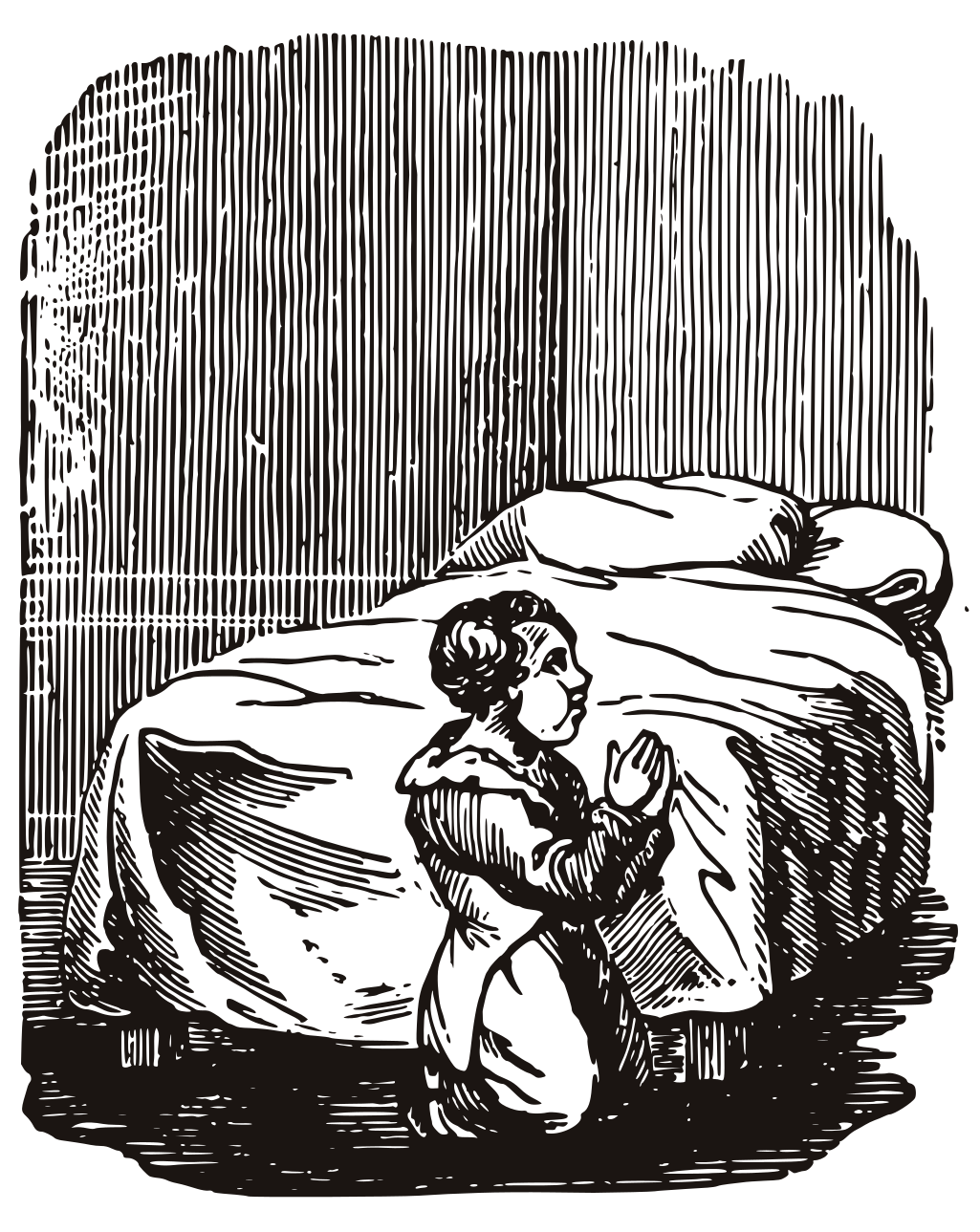
Ye ask and receive not, because ye ask amiss.
James iv. 3.
“All is not gold that glitters.” And all is not prayer that seems to be such. It is a fact that prayer of some sort forms a part of worship everywhere. All nations have a word that means prayer. But is it of the right kind? Is it prayer? If it is, why is so little good done by it? If it is not, we ought to know it. To many it might be said: “Ye ask and receive not, because ye ask amiss.”
The postures which we use will not make us to be heard, nor cause us to fail to be heard. David lay on the ground and prayed all night for his child, but it died. Hezekiah lay in his bed with his face towards the wall, and prayed, and God added fifteen years to his life. The Pharisees stood at the corners of the street and prayed, and were not heard. The publican “stood afar off” from the rest, in the temple, and prayed, and was heard. We ought to assume a posture of reverence. Kneeling is a very proper posture. But the posture may be right and the prayer worthless.
So we may use the words of Scripture, or of some other man, or men, or we may use our own words, and we will be heard, or not heard, according as our hearts are right or wrong. Our words may be very poor, and yet God may hear us. Our words may be very fine, and yet we may get no blessing.
Neither is God confined to any time or place. We ought to be as much alone as we can, when we offer our secret prayers. But it is right to unite with others in social and public prayers in our houses and in the house of God, on the Lord’s day and on all days.
Whether God will hear a prayer does not depend on its being long or short. Repetitions are not forbidden, but “vain repetitions” are. The publican’s prayer was short and was heard. The Pharisee’s was long, and wordy, and good for nothing. Still prayers may be too long. “Let thy words be few.”*
* Ecc. v. 2.
But we ask amiss, when we do not really wish for the things we ask for. This is mocking God. Yet I fear many do it. Augustine says, that at one time he prayed to be preserved from a particular sin, “but not yet.” See to it that you truly desire what you ask for.
We also ask amiss, when we do not look and long for an answer to our prayers. It is wrong to leave a prayer as the ostrich leaves her egg in the sand, to take care of itself. When we send a letter to a friend, we look for an answer, until one comes. So if we are in good earnest when we pray, we will at last cry out: “O Lord, how long?”
We also pray in a sinful way, when we have some wicked end to reach by getting what we ask. “Ye ask and receive not, because ye ask amiss, that ye may consume it upon your lusts.” A man may pray for life, or health, or wealth, or wisdom, merely to please himself, and not care whether he honours God or not, so that he gets what he asks.
If we would get what we ask, we must be careful to do to others as we ask God to do to us. If you would obtain mercy from God, be careful to show mercy to all around you. If you ask God to make you happy, try to make every one around you happy. If you wish God to pardon you, you must not hate those who have done you harm. “With what measure ye mete, it shall be measured to you again.” “If ye forgive not men their trespasses, neither will your heavenly Father forgive you your trespasses.”
We ask amiss, when we are not willing to do or suffer what God may send upon us. A man may pray for a good harvest, yet if he sows no seed, the rich harvest will not come. We may ask to be made holy, but if we will not do what God tells us, and try to avoid sin, we will not be made holy. We must in our hearts hate all sin, if we would have our prayers heard. “If I regard iniquity in my heart, the Lord will not hear me.”*
* Ps. lxvi. 18.
We ask amiss, when we think hard of God for not giving us at once all we ask for. We must be patient, and wait his time. “Blessed are all they that wait for him.”† “I waited patiently for the Lord, and he inclined unto me and heard my cry.”‡ Again, “I wait for the Lord, my soul doth wait, and in his word do I hope. My soul waiteth for the Lord more than they that watch for the morning; I say, more than they that watch for the morning.”*
† Isaiah xxxviii. 18.
‡ Ps. xl. 1.
* Ps. cxxx. 5, 6.
We ask amiss, when we do not ask in faith. “He that cometh to God must believe that he is, and that he is the rewarder of them that diligently seek him.” Without faith it is impossible to please him. We must see to it that we have faith in God, and that we believe in Jesus. We must ask all in the name of Christ. He is worthy. He says, “If ye ask any thing in my name, I will do it.” And our hearts must be in our prayers.
Let us not ask amiss, but let us ask aright. If we do ask aright, it will show that we have true piety. All God’s people pray. Prayer is one of the first things that a new-born soul delights in. None of God’s children are born dumb. As soon as bloody Saul of Tarsus had a new heart, it was said of him, “Behold he prayeth.” And if we ask aright, we shall get what we ask for, or something better. For Christ has said, “Ask, and it shall be given you; seek, and ye shall find; knock, and it shall be opened unto you.” And, “If ye being evil know how to give good gifts unto your children, how much more shall your Father, who is in heaven, give good things to them that ask him.”*
* Matt. vii. 7, 11.
“Jesus the Lord will hear
His people when they cry,
Yes, though He may a while forbear,
He’ll help them from on high.
“His nature, truth, and love,
Engage him on their side;
When they are grieved, his bowels move,
And can they be denied?
“Then let us earnest be,
And never faint in prayer;
He loves our importunity,
And makes our cause his care.”
Prayer
O Lord, teach us to pray. We know not what to ask for, nor how to ask for any thing. Give us true faith. Show us our sins, and our wants. Take away all iniquity, and receive us graciously. Help us to learn what our duty is, and then give us grace to do it. We are poor, and blind, and naked. Clothe us with thy salvation. Send thy Spirit to open our eyes, and to take of the things of Christ and show them unto us. Make us rich with the gifts of thy grace, for Jesus’ sake. Amen.
From Short Sermons to Little Children (1848). Page numbers refer to the 1848 American Sunday-School Union printing. Source: Internet Archive, shortsermonstoli00plum.